How a fast-growing junior game, seven southern Two-Touch conferences and a league still finding its feet produced Junior Bowl ’87 at Loftus Road.
Loftus Road, 20 September 1987
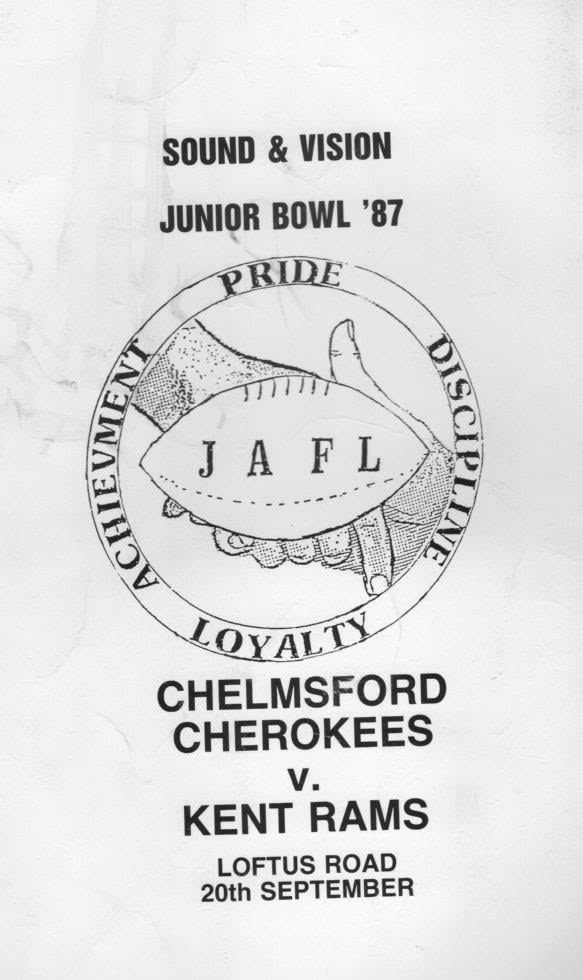
By the time Kent Rams and Chelmsford Cherokees took the field at Loftus Road on 20 September 1987, almost 4,000 people were already inside the stadium.
They were there ahead of Bud Bowl, but first came the junior game. The Sound and Vision Junior Bowl was the culmination of the first competitive season of the Junior American Football League — a season that had begun with organisers trying to bring order to a fast-growing collection of youth teams spread across Britain.
Kent and Chelmsford represented two very different routes to the final. Chelmsford had been one of the dominant sides of the regular season, finishing unbeaten in the Eastern Conference. Kent had come through a tighter London Eastern campaign before surviving a difficult playoff route.
The surviving contemporary account tells us that Kent were behind at half-time. In the second half they began to break through the Chelmsford defence, with Receiver later using a run by Kent’s Nicky Thomas as an example of the momentum turning.
Kent finished the afternoon as junior champions. Later compiled records give the score as 24–8 to the Rams. Contemporary material confirms the date, venue, finalists, Kent’s victory and the half-time turnaround, although the surviving programme and Receiver material do not themselves print that final score.
For the players receiving the trophy at Loftus Road, that was the end of one season. For British junior American football, it was really only the beginning.
Before the league, there was a problem
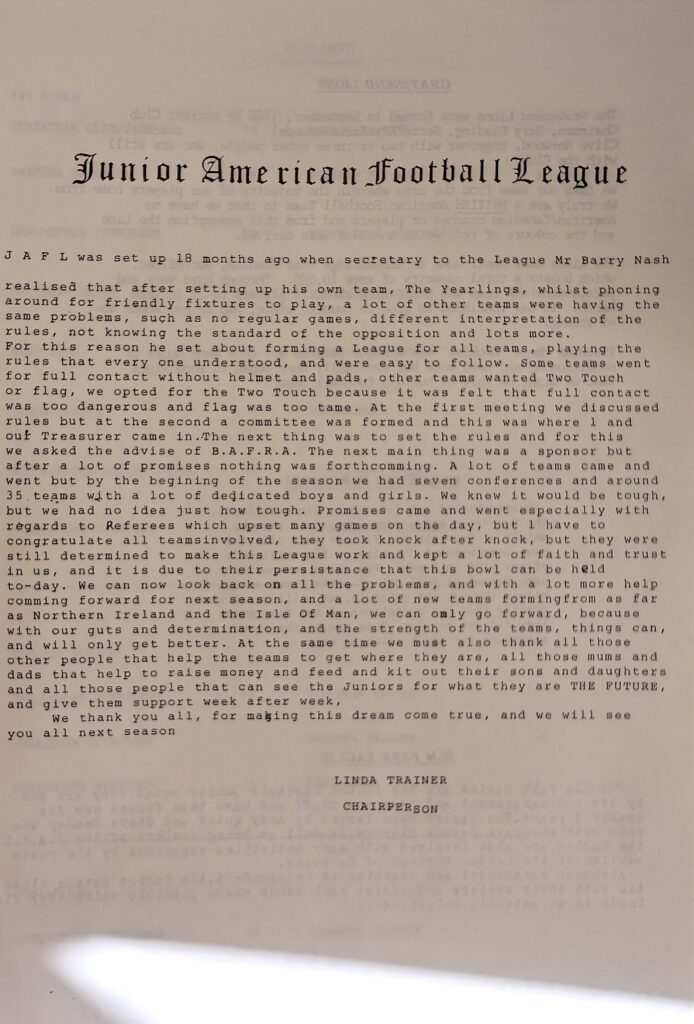
The roots of the JAFL went back roughly 18 months before the Bowl.
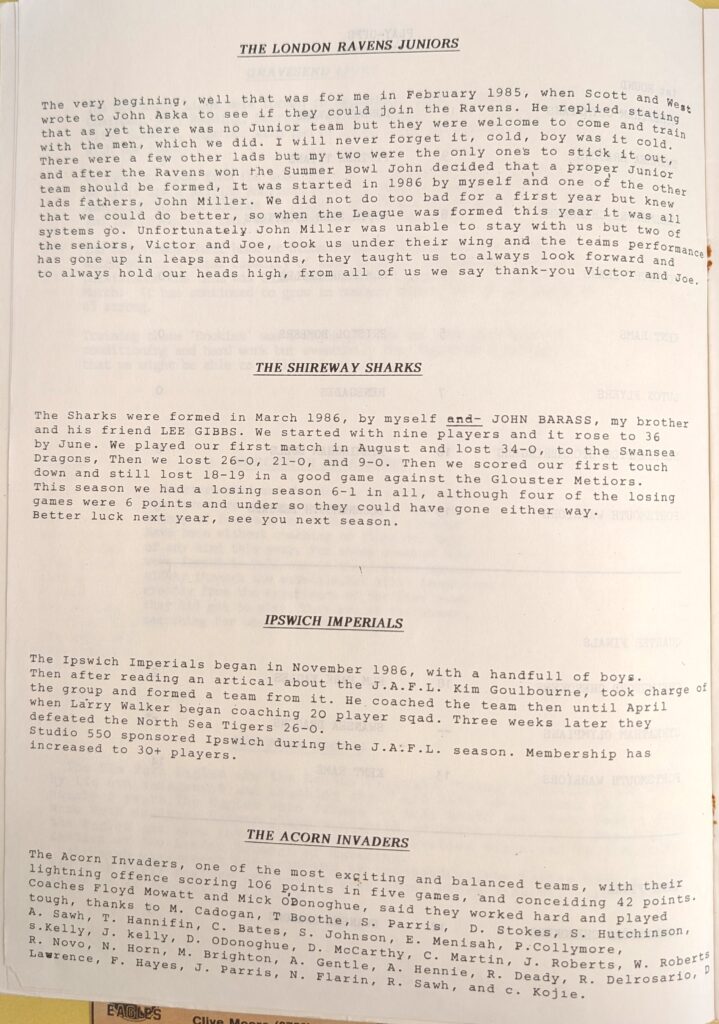
In the Junior Bowl programme, league chairperson Linda Trainer explained that Barry Nash had already established a junior side, The Yearlings, but had run into the same problems faced by many new teams: arranging regular games was difficult, opponents were of uncertain standard and even the rules could vary from one fixture to the next.
The obvious answer was to create something more organised.
Nash began working towards a league in which teams could play regular opposition under a common set of rules. A committee followed, with Trainer and others becoming involved in what was still a young administrative structure.
The distinction between the organisations mattered. The Junior American Football Association — JAFA — was the wider association, while the Junior American Football League — JAFL — was the league operating within that developing structure. Contemporary Receiver coverage independently identified Nash as Honorary Secretary of the JAFL and chairman of JAFA, and showed the association trying to expand junior football nationally.
This was not the birth of junior American football in Britain. Junior and youth teams already existed, and regional activity pre-dated the 1987 JAFL season.
What changed in 1987 was the attempt to turn a growing movement into a regular competitive league.
Why Two-Touch?
One of the first questions was what sort of football the new league should actually play.
According to Trainer’s account, clubs did not all agree. Some wanted full-contact football, some preferred flag and others favoured Two-Touch.
JAFL settled on Two-Touch.
The reasoning was practical. Full contact without the necessary equipment and infrastructure was considered too dangerous, while flag was regarded by the organisers as not physical enough for what they were trying to create. Two-Touch became the compromise. BAFRA was also approached for help with the developing rules and, later, with the difficult job of finding officials.
That decision did not mean the rest of the country followed one single format.
By the following February, Receiver described a developing North-South divide: the South had stuck with Two-Touch while the North was playing flag. In October 1987, Crewe Missiles beat Manchester Allstars Colts 22–16 in a separate JAFA Northern flag final.
The junior game in 1987 was therefore not one neat national pyramid. It was several ideas developing at the same time.
Building a league while the season was happening
Perhaps the most striking thing about the contemporary record is how fluid everything still was.
In June, Receiver’s Half Way Line section reported that more than fifty junior clubs had launched during the season. That did not mean fifty teams were all playing in the same competition. Some were league members, others were still looking for opponents, some were novice clubs and others were preparing for future seasons.
Even the JAFL conference structure printed in June did not remain intact.
That early version included names such as Enfield Bullets, Poole Chargers, Teddington Crusaders and Silverbacks. Some later disappeared from the final standings, while other names changed or became clearer as the season progressed. The Yearlings listed in Bedford correspond with the Milton Keynes Yearlings, who were based in Bedford, while Gloster Meteors were part of the early Western structure before withdrawing.
The final reconstructed tables contain 33 teams, while two Western entrants are recorded as early withdrawals. That fits remarkably closely with Trainer’s contemporary description of around 35 teams being involved at the start of the season.
There was also a separate northern list of JAFL clubs whose divisions had not yet been settled. Bradford Dolphins, Crewe Missiles, Leeds Cougars, Manchester All Stars, Manchester Spartans and others all appeared in that developing structure. Later evidence showing the North playing flag helps explain why they do not appear in the seven-conference southern Two-Touch tables.
The league was growing faster than its administration could settle.
The problems behind the progress
Growth brought practical problems.
JAFA was actively looking for regional commissioners to connect clubs, players, coaches, referees and officials. At one stage only four of twelve proposed areas were covered.
New teams were asking basic questions: who could they play, where could they play, how could they find a pitch, how would they travel, where would kit come from and who would provide adult support?
The July edition of Half Way Line laid those problems out almost as a guide for clubs trying to get started. It even highlighted East Kilbride Pirates, who had been training and organising for more than a year while waiting for a game.
Refereeing was another major issue.
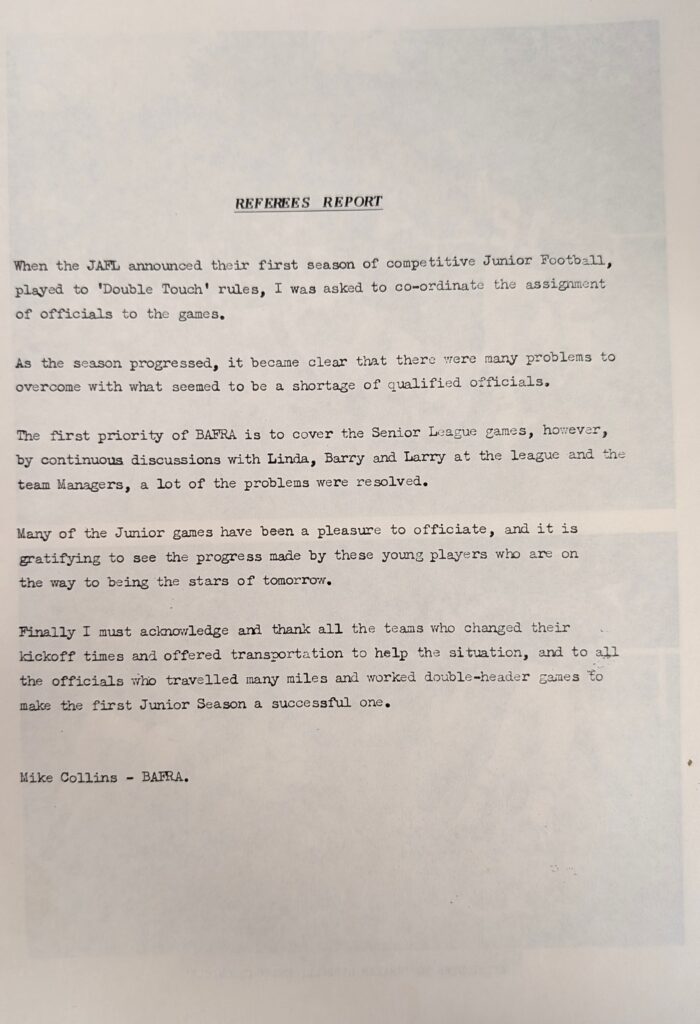
The league had approached BAFRA for advice when establishing its rules, and Mike Collins later described the difficulty of finding qualified officials for junior fixtures. Senior games understandably had priority, which left the JAFL trying to cover a growing schedule with limited resources.
Teams sometimes changed kick-off times or helped with transport simply to make officiating possible.
The scale of interest could be remarkable. A contemporary letter about Luton’s junior programme said well over one hundred hopefuls attended the first session after the junior side was brought more closely under the senior club’s wing.
There was enthusiasm everywhere. The challenge was turning it into a competition that worked from week to week.
Seven conferences begin to take shape
By the time the season settled, seven southern Two-Touch conferences had emerged.
Chelmsford Cherokees went 8–0 in the Eastern Conference. Luton Junior Flyers finished 9–1 in the Home Counties. Coventry Bears led the Midlands at 7–1, while Portsmouth Warriors went unbeaten at 6–0 in the Southern Conference.
The Western Conference was much tighter, with Swansea Dragons and Bristol Bombers both finishing 4–1–1. Kent Rams led London Eastern at 4–1–1, while Streatham Olympians went through the London Western schedule unbeaten. These records come from the later statistical reconstruction of the season rather than a surviving contemporary final table.
For many of the teams, simply reaching that point represented significant progress.
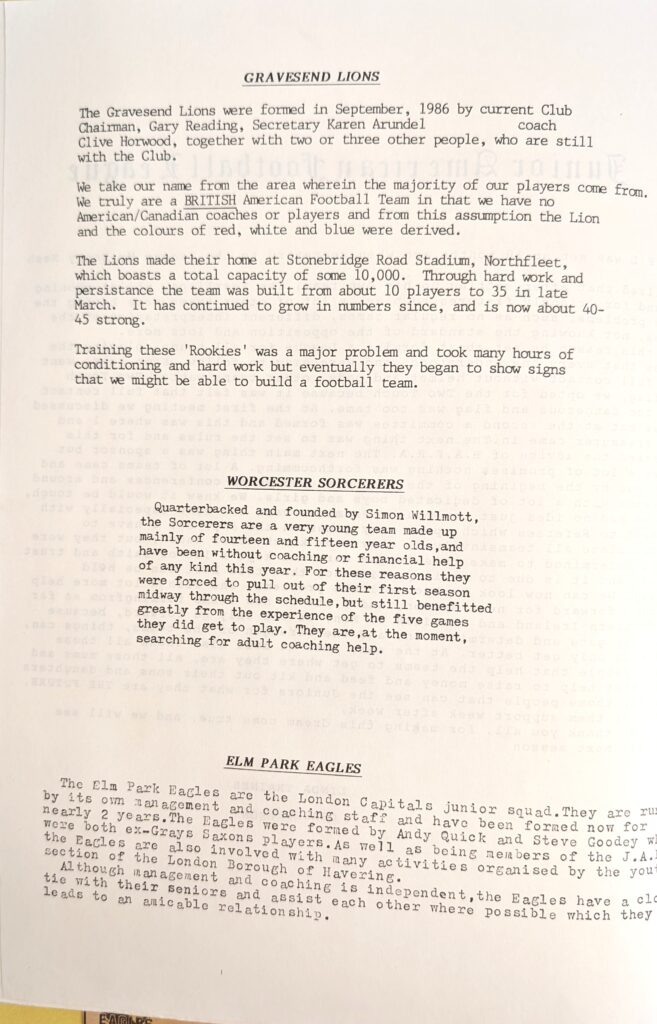
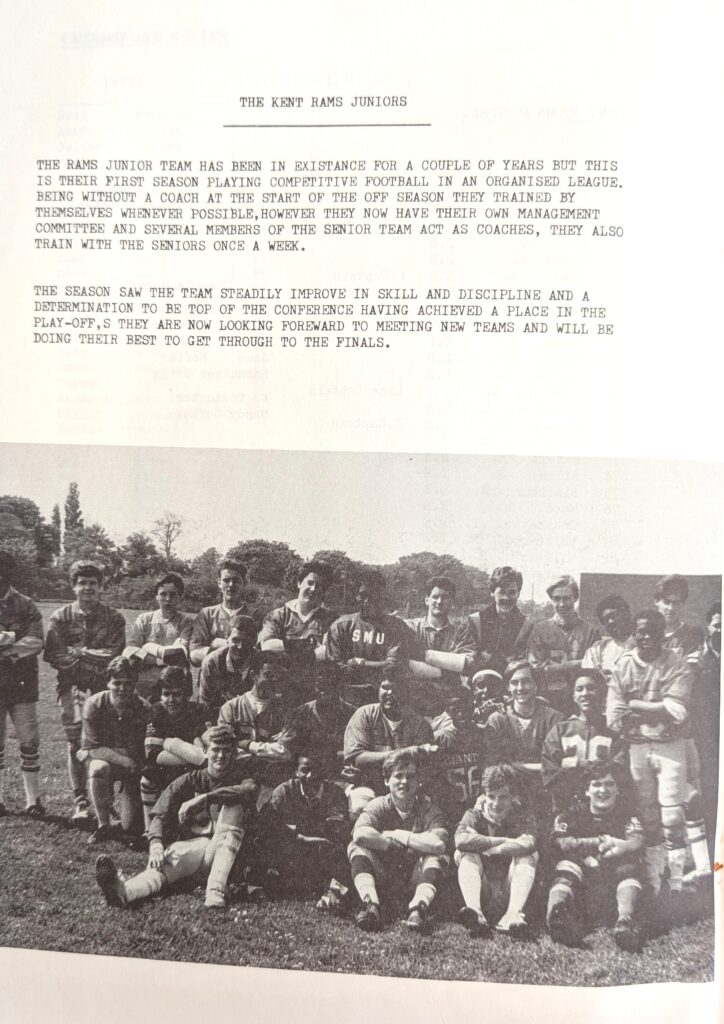
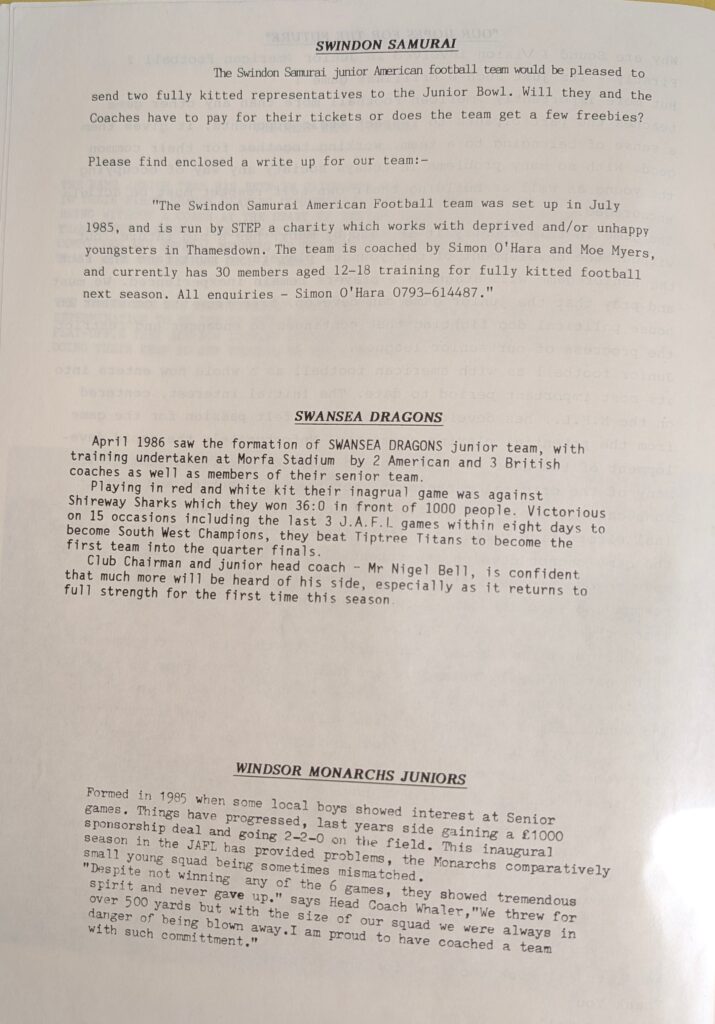
Kent’s own programme profile explained that its junior side had existed for a couple of years, but that 1987 was its first season playing competitive football in an organised league. The Rams had even started the year without a coach, initially training by committee before members of the senior organisation became more involved.
By the end of the summer, those improvised beginnings had become a playoff race.
The road to Junior Bowl ’87
The first round quickly reduced the field.
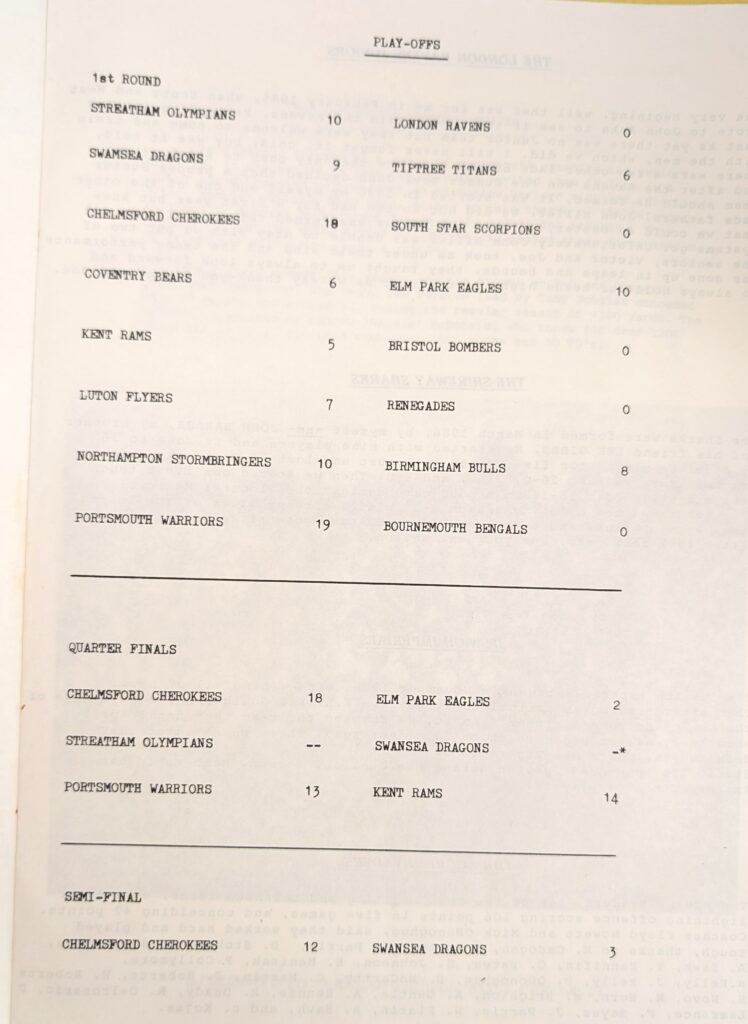
Chelmsford beat South Star Scorpions 18–0. Portsmouth defeated Bournemouth Bengals 19–0. Swansea edged Tiptree 9–6. Luton beat the Renegades 7–0, while Kent advanced past Bristol 5–0.
Elm Park Eagles beat Coventry 10–6, while the contemporary Bowl programme records Northampton Stormbringers beating Birmingham Bulls 10–8 — one of the places where the programme differs from the later statistical compilation.
The quarter-finals tightened the field further.
Kent survived one of the closest games of the postseason, beating Portsmouth 14–13. Luton shut out Northants 14–0. Chelmsford defeated Elm Park 18–2.
The remaining tie, Streatham against Swansea, did not follow the normal route.
Streatham were removed from the playoffs following a disciplinary decision and Swansea advanced. Some later records represent the outcome as a 1–0 award, but it should not be treated as a game that was actually played to a 1–0 score. More detailed allegations that later became attached to the incident have not been supported by the contemporary material examined so far.
That left four.
Chelmsford beat Swansea 12–3 in one semi-final.
In the other, Kent shut out Luton 6–0.
The first JAFL season had its finalists.
Kent Rams v Chelmsford Cherokees
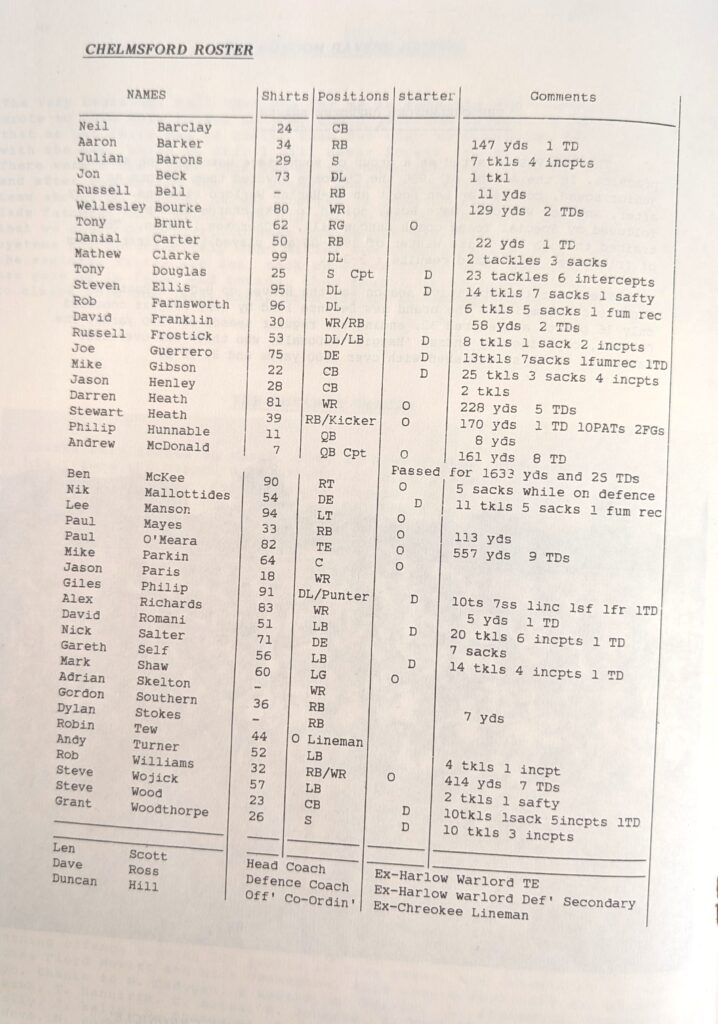
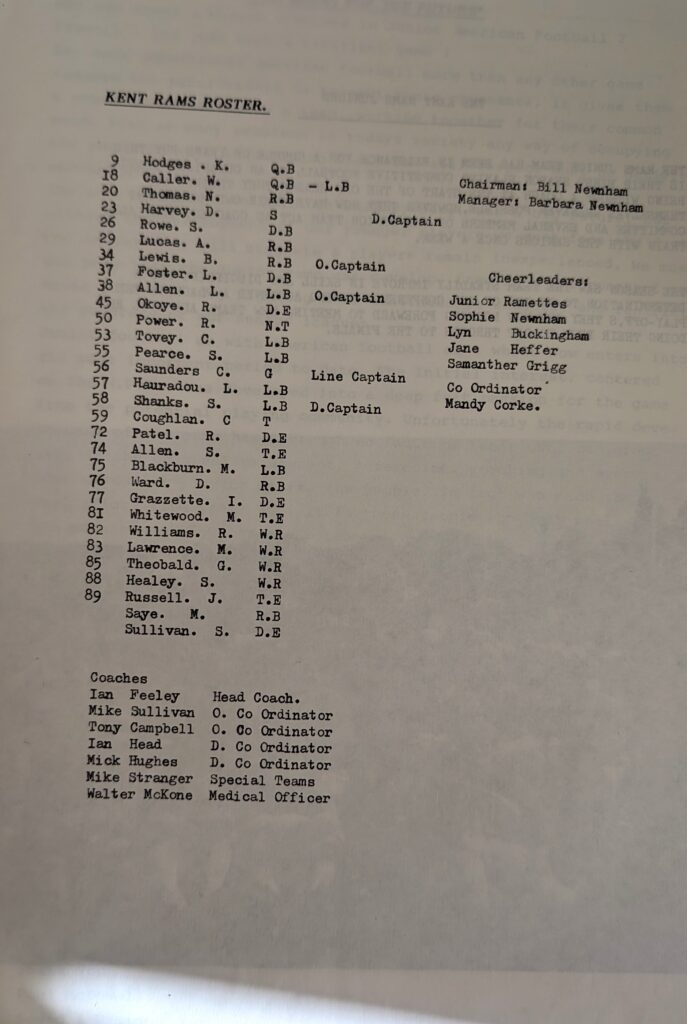
The Junior Bowl programme listed Ian Feeley as Kent Rams head coach and Len Scott as head coach of the Chelmsford Cherokees.
Chelmsford arrived with the stronger regular-season record. They had gone through the Eastern Conference unbeaten and had conceded little on the way through the playoffs.
Kent’s route had been less straightforward. Their London Eastern record was 4–1–1, and Portsmouth had pushed them to within a single point in the quarter-final.
But the final did not follow the form book all the way through.
Receiver’s November issue carried photographs from the game. One caption records that Kent had been trailing at half-time before finding a way through the Chelmsford defence in the second half. Another photograph shows Nicky Thomas carrying the ball for the Rams.
The same issue provides the most important post-game confirmation: Richard Williams is pictured receiving the junior championship trophy for Kent Rams from the BAFA chairman. The match photographs were credited to Wayne Paul.
That establishes the winner beyond the later statistical record.
What the contemporary material does not currently provide is the full scoring sequence, the half-time score or the individual scorers.
Later BritballNow records consistently give the final as:
Kent Rams 24–8 Chelmsford Cherokees
Until a contemporary post-game score report is located, that result is best understood as a strong later reconstruction rather than a score taken directly from the surviving programme or Receiver.
From a planned Bowl in Essex to Loftus Road
The final itself also shows how quickly plans were changing.
In June, Receiver advertised a proposed “National Bowl” for Sunday 27 September at the Essex County Show Ground. Super X was named as sponsor, Len Scott as the JAFA organiser and transport assistance was being discussed for finalists.
That was not the event that eventually took place.
Instead, on 20 September, Kent and Chelmsford met at Loftus Road in the Sound and Vision Junior Bowl, staged as the curtain-raiser to Bud Bowl. Nearly 4,000 spectators were already inside the ground.
For a league that had spent much of the year trying to find enough referees, settle its conferences and help new teams arrange fixtures, the setting could hardly have been more different from where the season had begun.
What 1987 left behind
The importance of 1987 is not that junior American football suddenly appeared that year.
It did not.
Its importance is that the JAFL managed to turn an already growing junior scene into a competitive league.
The season was imperfect. Teams came and went. Conference membership shifted. Names changed. Some clubs were still searching for opponents while others were already considering fully-kitted football. The North and South were developing different formats, and the governing structure itself was still evolving. Contemporary evidence shows a much larger junior movement around the final 33-team southern table, including novice clubs, provisional entrants and northern flag teams.
But the competition happened.
Seven southern Two-Touch conferences were played. A postseason was completed. Kent Rams and Chelmsford Cherokees reached Loftus Road.
Kent lifted the trophy.
The Junior Bowl was therefore more than simply the last game of the season.
It was evidence that British junior American football had moved from scattered friendlies and local initiatives towards something recognisably organised.
For Kent Rams, 20 September 1987 ended with a championship trophy.
For the JAFL, it proved the idea could work.