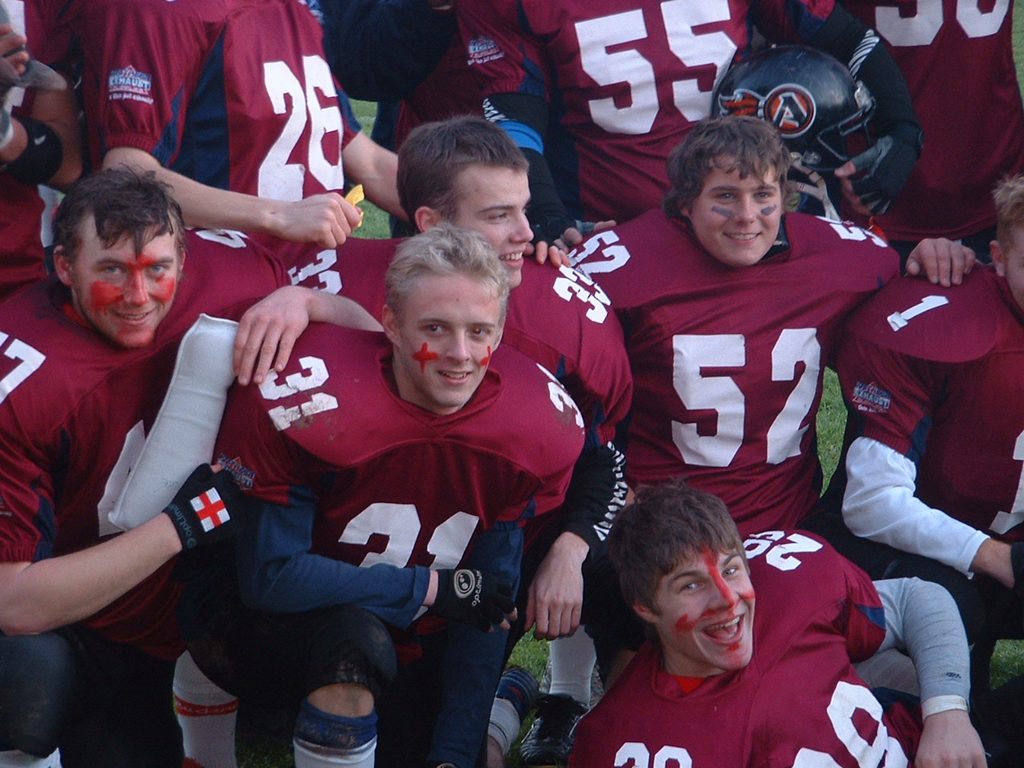
Chris Taylor
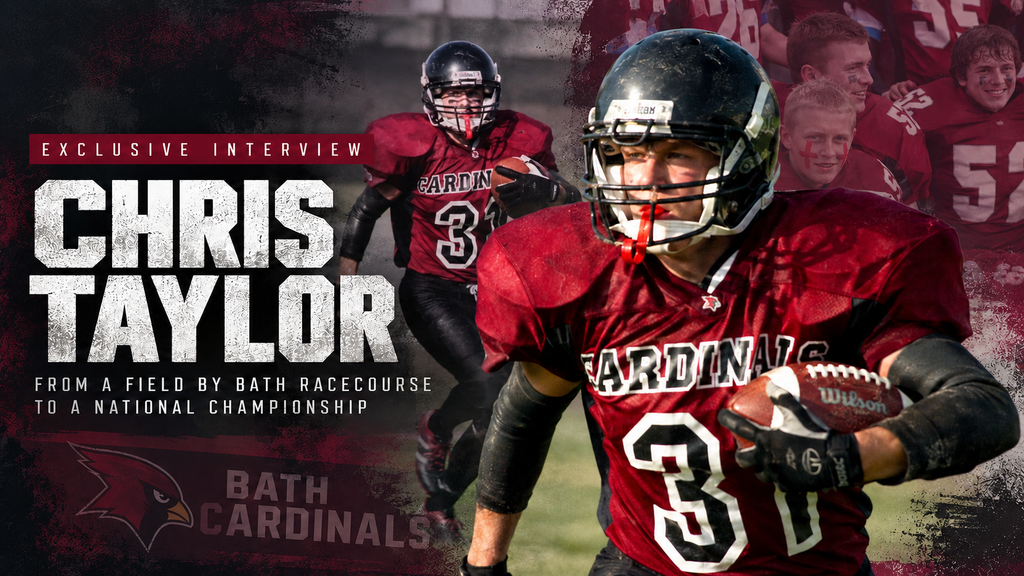
Twenty-two years ago, Chris Taylor scored both of Bath Cardinals’ touchdowns as they defeated the North Lanarkshire Rams to win BYAFA Bowl XVI. His journey to that championship game had begun in considerably less glamorous surroundings — climbing over a gate into a field near Bath Racecourse, wearing equipment that had already seen several generations of British American football.
Like many British players of his generation, Chris Taylor’s introduction to American football came through Channel 4.
“My dad started watching in the ’80s on Channel 4, so I’d grown up with an awareness of American football that became an interest, but I hadn’t really considered playing.”
The opportunity came almost by accident.
While Chris was playing junior football, his father got talking to another parent. Both were Green Bay Packers fans, and the conversation eventually turned to a new American football team being formed in the Bath area.
“He said something along the lines of, ‘CT, you’re quick, do you want to come to a practice?’”
That team was the Bath Cardinals.
Humble beginnings
The Cardinals of those early years were about as grassroots as British American football could get.
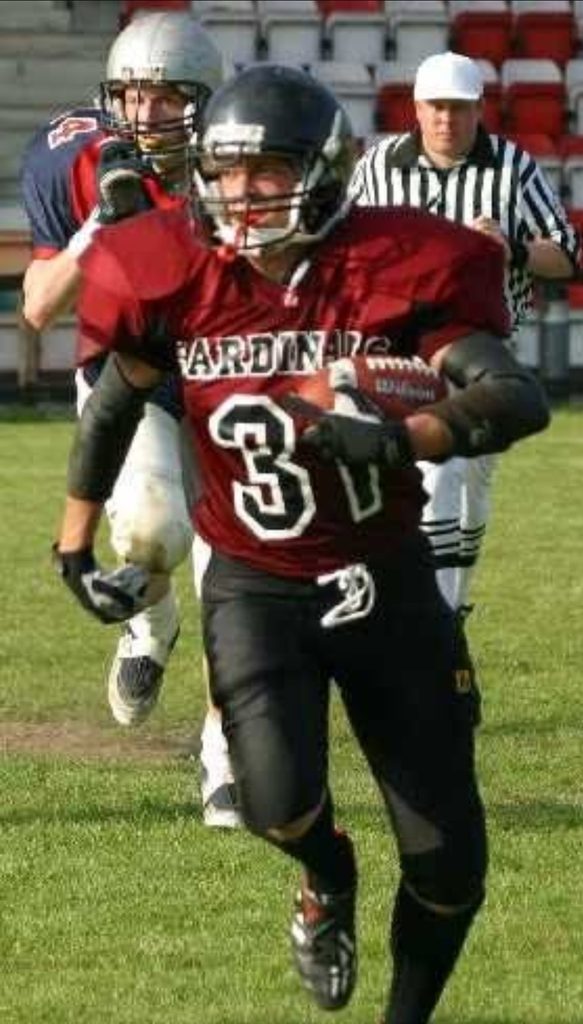
“For my first year we didn’t have a proper ground to use, so we had to drive to a lay-by near Bath Racecourse and hop a gate into an empty field to practice.
“Most of the kit was second, third or fourth hand — split padding in helmets, pads with missing or rusted clips, thigh pads that were three sizes too big.”
For a teenager in Britain at the beginning of the 2000s, playing American football still required a certain amount of explanation.
Chris’s family at least understood the attraction.
“Dad had been following for 20 years at that point, so there was a base level of knowledge.
“With friends or colleagues, it was like talking in different languages and I got a lot of blank stares.”
He initially joined the Cardinals as a wide receiver, but circumstances soon pushed him towards playing on both sides of the football.
“Approaching our first league season when we were training, we’d end up just playing passball — I guess flag now — due to low numbers.
“One week one of the defensive coaches noticed that I was good in coverage, or just that I could backpedal, and asked if I wanted to move to corner.”
Then came another move.
“Mid-season the following year, I think we were a bit short at running back, so I ended up there in practice, had a few plays towards the end of the regular season and became a starter for the playoffs.”
Chris enjoyed both roles.
“I loved playing both sides of the ball but usually felt more involved in the result on offence.”
That would certainly prove true in 2004.
The Bath Cardinals
Chris remembers the Cardinals as a team capable of balancing competitiveness with enjoying themselves.
“It was a great squad to be a part of. We always took the football seriously but were able to have fun at the same time.
“There was a large contingent of Chippenham RFC players who really formed the core of that team and set the tone on the field.”
Among the names that immediately come back to him are Tom Evans — whose father had helped bring Chris to the club in the first place — Kyle Latore, Karl Adams and Steve Onditi.
And with those names come the stories.
The night before the 2004 National Championship, the Cardinals were staying in a hotel while England were playing Austria in a World Cup qualifier.
“Onditi was wandering around the lobby with a camcorder, wearing a shower cap from his room shouting, ‘G’Day mate.’
“I’m still not sure if this was trolling or he really confused Austria with Australia.”
There were plenty of other moments that could only really have happened in grassroots British American football.
“For our first home league game, we’d arranged to have full logos painted on the field, only they’d used industrial paint and it killed the grass.”
Another incident occurred after the team had received a new set of uniforms.
“One year when we got our new kits, we had a handing-out event and some of us went out afterwards.
“At one point a couple of guys decided they didn’t like the look of us and singled me out as the smallest one.
“Our linemen had to block for me down the street to get away from them.”
Among the coaches, one person stands above the rest in Chris’s memories.
“Coach Bob would be the biggest influence, providing the basics of the game, giving me the self-belief to become a better player and my first experience as a coach.”
A championship-calibre team
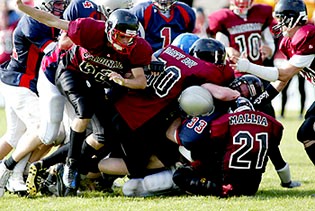
The 2004 Cardinals entered the season with good reason to believe they could compete for a British title.
They had gone 5–0 the previous year before suffering a narrow playoff defeat, while several members of the squad had subsequently represented England against Scotland in December 2003.
England won that game 29–3.
“We were confident that we’d be one of the best teams that year.”
Bath went 5–1 in the Southern Conference, but one opponent in particular provided the edge to their season.
Bristol.
“It was an ill-tempered rivalry with Bristol, which I think went back to how the Cardinals were formed by some coaches and players who had been involved with the Aztecs.
“The games were hard fought.”
Bath edged one meeting 11–8 thanks to a remarkable 54-yard field goal before Bristol handed the Cardinals a humbling defeat in the return fixture.
But the teams would meet once more.
This time it was the playoffs.
“That gave us added motivation for the playoff game.
“I took a lot of pleasure in scoring two 40-plus-yard touchdowns, having given up a touchdown while playing corner in that loss.”
Bath won the Championship playoff 26–0.
The Cardinals were going to the National Final.
Another team Chris remembers fondly from those years were the Lancashire Wolverines.
“We always looked forward to playing the Lancashire Wolverines. We’d faced them at the Festival of Football in Redditch in ’03, then again in the playoffs before playing with them for England.
“Dave Mead, Sam Fogg, Jonathan Kohler and Lex Dunn stand out from that team.”
BYAFA Bowl XVI
On 5 September 2004, Bath arrived at Ram Stadium in Dewsbury to face the North Lanarkshire Rams for the British Youth American Football Association championship.
For some of the Cardinals, the surroundings were already familiar.
“We’d followed the same routine as some of us had for the England game in Dewsbury the year before, so while it felt like a more important game, the occasion wasn’t overwhelming.”
The contemporary account of Bowl XVI paints a wonderfully British picture of championship football.
Access to the stadium was reportedly complicated by a car boot sale and the game itself was even interrupted while officials moved their cars.
Chris remembers rather less of the chaos.
“It wouldn’t be the last time I’d experience travel or parking difficulties before games, and in-game delays aren’t uncommon, so it doesn’t really stand out.”
What does stand out is what happened on the field.
North Lanarkshire took a 14–12 lead into the latter stages of the game, but there was no sense of panic on the Cardinals sideline.
“We wouldn’t have let that get to us.
“Coach Bob was always very positive about our prospects in any given game or situation and we didn’t lack confidence in ourselves.”
Chris had already scored one touchdown.
And, more than two decades later, he would like the historical record corrected about exactly how it happened.
The contemporary report described it as a nine-yard run in which Taylor fumbled over the goal line before recovering the football himself.
Chris has a different recollection.
“Fake News!”
According to the man carrying the ball, there was no fumble before the touchdown.
“The line judge confirmed on the field that I broke the plane before the ball was knocked out.
“We’d called a dive play and our guard, Karl Adams, turned to me and said, ‘Just follow me.’
“I did and walked into the end zone before a Ram knocked the ball loose.
“But I jumped on it just to make sure.”
Touchdown Bath Cardinals. No fumble. History officially amended.
But Taylor wasn’t finished.
With Bath trailing 14–12, the Cardinals called an option play.
What happened next would decide a National Championship.
Chris’s description is typically understated.
“Not as interesting as the first one.
“We’d called an option. I just had to use my speed to get to the sideline and turn upfield and, thanks to the blocking, no-one was there to catch me.”
Taylor raced down the field for the touchdown.
Bath had the lead.
And this time they would not give it back.
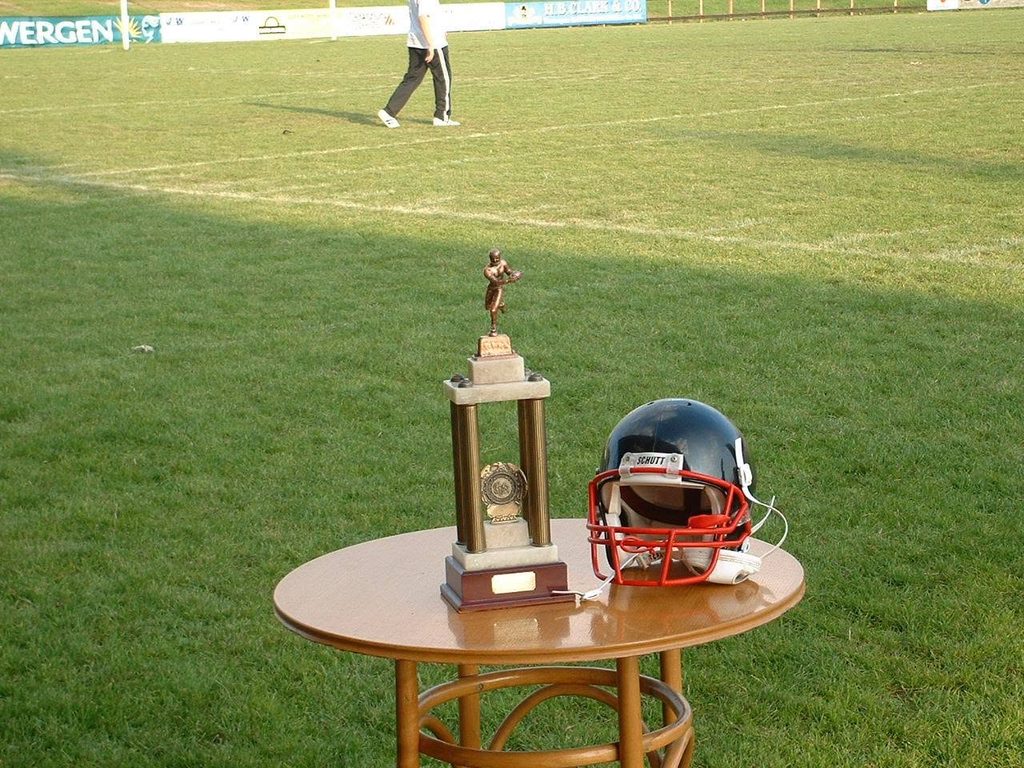
The Bath Cardinals were National Champions.
More than a championship
More than two decades later, trophies and touchdowns are not the only things Chris took from American football.
Asked what the sport gave him, his answer is concise.
“Self-belief, assertiveness and various minor injuries.”
And what would the experienced Chris Taylor tell the teenager who climbed over that gate near Bath Racecourse for one of his first Cardinals practices?
“Hit the gym and study the game more. It’s a big jump to adult ball.
“Not that teenage me would have listened.”
From borrowed and battered equipment in an empty field to scoring the winning touchdown in a British National Championship, it was quite a journey.
And thanks to Chris, there is one small correction we can now make to the story of BYAFA Bowl XVI.
He did not fumble before scoring that first touchdown.
Just ask the line judge.